Category Archives: Construction
POLYPIPE BUILDING PRODUCTS
Story


SAVING A FREE, VITAL COMMODITY – IT’S COMMON SENSE
There’s not much that comes for free in life, but in the UK we are lucky that there is something we get a lot of, that costs us nothing. Sadly we take it for granted most of the time, even bad mouth it, so much of it is wasted.
Water is the most precious commodity we have on this planet and there’s plenty of it. But less than 2% of what we have is fresh water. We need it for the basic necessities of everyday life – we drink it, we need it to maintain good hygiene, it’s required for the manufacture of most of our food and for pretty much every key product in our everyday lives. There is no alternative.
With forecasts suggesting that the south coast could be experiencing a Mediterranean climate by 2050, water could become a very expensive commodity and any help available from naturally occurring sources of water should be met with open arms. The UK’s position as an island, with prevailing winds for much of the time heading at us from the south west across the Atlantic Ocean – and a warm current into the bargain – does give us a number of benefits and conserving precious rainwater supplies clearly makes sense. ‘Now’ would not be a moment too soon to take rainwater harvesting seriously.
An amazing one third of all water used in the home gets flushed down the toilet – and in most homes, that’s drinking quality water. The roof on an average 4-bed family home can capture more than 100,000 litres of rainwater each year – most of which currently goes down the drain and is wasted. When you think that a typical family uses 70,000 litres of water each year on flushing the toilet, clothes washing and outdoor use – watering the garden and cleaning cars – it simply makes sense to harvest it and use it and save on your water bills into the bargain.
And like most good ideas it’s not new. Rainwater harvesting as we understand it today, was first practised seriously in about 300BC in Baluchistan – present day Pakistan and Afghanistan! Even earlier in a way, in ancient Egypt. In some parts of India, rainwater harvesting is compulsory – every home in Tamil Nadu has to have a rainwater harvesting system. China and Brazil are the leading rooftop rainwater harvesting nations today and as usual, rainwater harvesting has been practised extensively across Europe, before we in the UK arrived at it a little late in our history. But we are beginning to embrace the technology wholeheartedly now, as parts of the UK – East Anglia in particular, are becoming extremely dry with reducing amounts of rainfall over the year.
It’s clearly far easier to install a rainwater harvesting system in a new build property than to retrofit one to an existing property with all the existing below ground infrastructure although that isn’t stopping many people from adding a rainwater harvestings system to an existing property – it just means making a bit more effort and a bit more thought to find the right location for tanks and pipework. Selfbuilders are increasingly incorporating rainwater harvesting systems to their dream homes and we are seeing significantly more systems fitted to social housing developments – reuse of rainwater contributing to the targets for the Code for Sustainable Homes. It seems here in the UK we’ve woken up to the possibilities of rainwater harvesting a little late in the day but now we have, we’re taking the concept to our hearts.
Here in the UK the majority of rainwater harvesting systems are still specified by architects or developers as part of the plans for a new property, and the contractors are left to find the system that suits the property best. There are two types of rainwater harvesting system available in the UK from the main suppliers. They are available as gravity fed or pressurised systems. Within a gravity fed system, water is pumped from the usually underground collection tank to a header tank in the loft of the property the system serves. The water is then fed to each appliance by gravity. Pressurised systems use a pump to feed water directly to the appliance or appliances in the property on demand. In the main, the RWH units come pre-assembled ready for installation – you can select from a wide range of tank sizes to meet your specific needs – and the rainwater harvested by the system goes through a usually three stage filtration process, down to around 130 microns. Installation of a rainwater harvesting system will typically reduce mains water usage by around 50% – a valuable saving particularly if you’re on a metered water supply. The control panel is usually small and neat and it’s the only outward evidence that a house has a rainwater harvesting system on the property.
Polypipe Building Products has recently launched a new range of solutions into the rainwater harvesting marketplace, targeted specifically at the residential market and an ideal additional product for installer to get to grips with, offering them an additional potential income stream. It’s been launched in response to the growing acceptance that the time has come to stop using high quality drinking water to quite literally flush down the toilet.
Polypipe offers Rainstream – a range of rainwater harvesting options designed for everyone. Ideal for new build, for retrofit and already seeing major interest from the self-build marketplace, Rainstream is a very simple straightforward rainwater harvesting ‘package’. You can even see it on YouTube at www.youtube.com – just type in Polypipe Rainstream in the search bar!
….and Polypipe helps local college to get to grips with Rainwater harvesting…
And as part of the plan to support rainwater harvesting in the UK, Polypipe Building Products has responded to a request for some of the equipment it manufactures locally to help a local college to teach apprentices on a heating and plumbing course, run from Doncaster College in the town.
Polypipe has supplied a rainwater harvesting set up through builders merchants Crosslings, that will allow students on the course to understand how rainwater harvesting works. Ian Kennedy is the Programme Co-ordinator for Construction and the Built Environment at Doncaster College: “The partnership we have developed with Polypipe helps us a lot and in this case the equipment will help us with one of the modules on a course run by JTL Training here. Rainwater harvesting has been built into the curriculum reflecting its increasing importance.”
For more information click on to www.polypipe.com/building-products.
View Polypipe's profile:

Companies Have a Global Responsibility to Switch to LED Lighting, According to Honeywell ED&S
Story


Honeywell ED&S launches lighting consultancy service to support facilities managers switch to LED lighting
Honeywell Electrical Devices & Systems (ED&S) has called for a worldwide switch to LED lighting, claiming that organisations across the globe – large and small – have a responsibility to seriously consider this energy-efficient lighting in the drive to combat climate change and save energy.
With lighting representing on average 21 percent of a building’s total energy consumption(*1) and accounting for 19 percent of global energy production(*2), the global electrical products and systems company believes a switch to LED lighting could now be one of the biggest drivers of energy savings.
Energy savings can in fact equate to 60 percent when comparing a Honeywell LED tube at 23 watts with a typical fluorescent tube at 58 watts.
In order to aid companies that pledge to investigate the switch to LED technology, Honeywell ED&S has launched a free global consulting service. Through consultations, site surveys, devising bespoke lighting schemes, producing detailed energy and cost saving calculations and offering pilot installations, the company aims to arm facility and energy managers with a rigorous energy-saving and ROI assessment before making an investment.
“It’s been predicted that LED technology could dominate the lighting market by 2015 – but it needs to be sooner,” comments John Storey, Global Business Director of LED Lighting for Honeywell ED&S. “Currently, around two thirds of lighting is based on older, energy wasting technologies developed before 1970 – this is not sustainable.
“Until now though, the lighting industry has failed to deliver a much superior proposition to be used for general high-quality lighting in almost all applications. But we’re at a turning point. LED lighting is the most exciting thing since the electric light – and every bit as revolutionary. However, we recognise that the key issue for facilities and energy managers is justifying the initial investment to switch – that’s why we’ve launched our global consulting service, and our online energy calculator to empower them with answers to questions about the long-term return on investment through energy and cost savings.”
With a significantly longer life span of 60,000 hours compared to a traditional fluorescent tube lasting 10-15,000 hours, LED lighting lasts for an additional five years, and with a wider optimum temperature range, LED lighting is more effective as well as more efficient. According to the International Energy Agency, the worldwide switch to LED lighting could save energy consumption for lighting by 40 percent.
The switch to LED lighting is supported by global independent body, the Lighting Industry Association. Peter Hunt, Joint Chief Executive of the association, said: “The pace of change in LED technology has brought not just high efficiency but also the opportunity to improve the quality of the lit environment as manufacturers invest in continuous improvement.
“For facilities managers looking to reduce costs and meet energy targets, the switch to LED lighting is a logical, effective solution.”
To perform a quick energy-saving calculation between fluorescent and LED tubes, an online tool can be found at the campaign website. Please go to http://led.honeywell.com for more details.
Footnotes
(*1) – U.S. Environmental Protection Agency. 2009. Clean Energy Strategies for Local Government; Energy Efficiency in Local Government Facilities and Operations. June 2009. Found online at: http://www.epa.gov/statelocalclimate/documents/pdf/ ee_municipal_operations.pdf
(*2) – International Energy Agency: International Energy Agency. 2006. Light’s Labour’s Lost – Policies for Energy- Efficient Lighting. Press release: (06)11. June 2006. Found online at: http://www.iea. org/press/pressdetail.asp?PRESS_REL_ID=182
View Honeywell Control Systems's profile:

SAINT-GOBAIN PAM UK'S BRITON ACCESS COVERS RANGE ACCREDITED TO HIGHEST LEVEL OF BS EN 124:1994
Story

The Briton access covers range from iron technology leader Saint-Gobain PAM UK, part of leading materials company Saint-Gobain, is now accredited to meet the exacting requirements of F900 for heavy duty loads, passing the most stringent level of the British Standards’ (BS) EN 124:1994.
Group 6 – the top level of the standard – stipulates that access covers and gratings must be able to withstand up to 90 tonnes of static load. Certified by the British Standards Institute, the accreditation means Saint-Gobain PAM UK’s Briton range is now suitable for sites where exceptionally heavy loads are the norm, such as airports and docks and is available in a range of clear opening sizes including 600mmx600mm, 675mmx675mm, 1220mmx685mm and 1840mmx685mm.
Paul Thompson, marketing manager – municipal castings of Saint-Gobain PAM UK, commented: “We are pleased to announce that our Briton access covers range now complies with the most stringent level of the BS EN 124:1994 standard, successfully passing a series of assessments and tests overseen by the British Standards Institute. Developed at our Holwell site in Melton Mowbray, customers can feel confident in the capabilities of a system which can safely withstand loads of at least 90 tonnes, guaranteeing a high level of quality and durability.”
For more information about the market-leading range of Briton access covers available from Saint-Gobain PAM UK, visit www.saint-gobain-pam.co.uk/access-press.
View PAM Building's profile:

VM ZINC wins test at Lords
Story


Zinc provides lasting colour on Members’ Pavilion
Ettwein Bridges’ design for the £8.2 million upgrading of Lords’ Grade II* listed Members' Pavilion, said to be one of the most celebrated, historic and beautiful buildings in world sport, was completed in April 2005. Following extensive consultations with the MCC, conservation organisations and local authorities, Richardson Roofing undertook construction of a new roof terrace using VMZINC interlocking panel facades and a roll cap roof in Quartz-Zinc®. The 8 years since completion have shown how effectively the zinc has retained its pre-weathered appearance, proving its suitability for such sensitive refurbishment work.
VMZINC faÇade and roofing systems are available in a dark charcoal ANTHRA-ZINC as well as the subtle PIGMENTO shades of green, blue, red and brown. The surface colour is created by adding mineral pigments to a durable protective coating, creating beautifully organic shades which enable the naturally grained texture of the metal to show through. All, including the natural zinc finish develop a natural self-protecting patina which is essentially maintenance-free.
View VM Zinc's profile:

Unistrut launches new cable trunking range
Story
View Unistrut's profile:

STELRAD SWINGS INTO ACTION!
Story
New towel rails and new decorative radiators now available
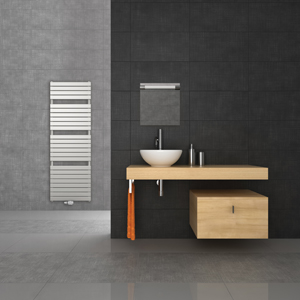 Leading radiator manufacturer Stelrad Radiators has introduced its brand new, curved vertical premium panel radiator to the UK market – the Stelrad Swing.
The new model is based on Stelrad’s extremely popular Compact Vertex radiator but sees the addition of a one piece, curved steel front cover that gives it a modern and aesthetically pleasing designer feel. It comes in white as standard but can be specially ordered in up to 35 colours, making it an extremely attractive product for interior designers and architects, looking to match radiator colours with corporate or specific colour décor.
The Swing is available in two heights – either 1,820 or 2,020mm – in two types – either P+ (T21) or K2 (Type 22) and in a choice of lengths – from 504 to 727mm – a total of 12 SKUs. Btu/hr outputs range from 4,176 up to 8,107 at Dt50.
Stelrad’s Marketing Manager Sarah Baker says the Swing is already attracting significant interest: “It’s a very stylish and instantly modern feeling radiator that will make the Swing a vital part of a room’s design. By introducing the Swing we’re continuing to see the radiator as very much a positive contributor to the décor. The quality, the look and the feel of a designer radiator makes a statement and adds to the validity of interior design. We’re confident that we’ll see a serious push for the Swing in the months ahead.”
 Stelrad Radiators has also unveiled two stunning additions to its collection of towel rails – range extensions to existing radiator designs.
Available now from Stelrad Radiator stockists around the country are the Caliente and Concord towel rails, both high quality exquisite radiators in their own right but now part of the ranges that bear their name.
The Caliente was launched at Ecobuild 2012, named in a competition by a customer visiting the show and entering a competition on the Stelrad stand: “Spanish for ‘heat’, Caliente has quickly become a favourite designer radiator model and adding a towel rail model to the range made huge sense, says Stelrads Sarah Baker. “We’ve introduced both single and double Caliente towel rail models – the attractive tubular finish will grace any bathroom, shower room or wet room environment.”
The Concord towel rail offers a sleek, flat tube design, that complements the four design options in the Concord range quite perfectly: “It’s a classic design that adds style and finesse to the décor of a bathroom,” says Sarah.
 Whilst the products come as standard in white, both new products are available in a range of 35 colours making matching and contrasting to colour schemes an exciting additional option
For more information on the portfolio of towel rail products and the new decorative offerings from Stelrad, visit www.stelrad.com, or call on 0870 849 8056. You can follow Stelrad on Twitter @Stelrad or on Facebook at www.facebook.com/stelradlimited.
View Stelrad's profile:

BDA REJECTS NOTION THAT THE BRICK INDUSTRY IS IN CRISIS
Story
The Brick Development Association, the body that represents the clay brick and paver industries in the United Kingdom and Ireland, has responded to recent comment about the state of the construction industry, citing that the positive growth over the last month is something that manufacturers have strategies and plans to manage.
In light of recent Government initiatives, and particularly in regards to the ‘Help to Buy’ scheme, and the ‘Get Britain Building Campaign’, the new build sector has very recently gained significant momentum. In combination with the recent good weather, the National House Building Council has reported that housing starts have risen by 18% for the three months leading up to May; equating to a 7% year on year market increase for brick manufacturing.
The effect of this increase in demand has been to revitalise the industry, and despite this sudden acceleration, the BDA is confident that manufacturers and merchants will be able to meet this demand.
Alan Baxter, Chairman of the BDA, commented:
“Undoubtedly, the initial successes of schemes such as Help to Buy and indeed the growing pace of the economic recovery, has meant that the construction industry in particular has faced an upswing in demand. However, there is absolutely no suggestion that manufacturers of clay bricks and pavers will be unable to deal with the increased demand.
The reality is that the market for bricks has declined by 5% last year and is still around 35% below 2007. Manufacturers have reduced production to adjust to the reduced demand levels experienced since 2008, with a few plants being closed and some being mothballed. They have also extended year end shutdowns extending into January and February each year to reduce production still further whilst also maintaining their brick ranges for their customers.
It is the sudden change in demand profile that has caused pressures on the manufacturers. This has arisen for a number of reasons, but a significant one has been the surprising announcement of the Help to Buy scheme in the March budget and its immediate obvious success. Increased demand for new homes has not only caused builders to want to increase output but also to catch up on production lost during the poor weather in the first quarter. In addition, Builders Merchants have sought to increase their brick stocks to more normal levels as they too have experience increased demand. Furthermore, brick customers have become accustomed to large stocks and therefore immediate availability since 2008.They now need to return to planning their deliveries and placing orders in advance as was standard practice prior to 2008 and the credit crisis.
These circumstances have all combined to create a period of very strong demand that the industry is responding to, but it will require some time to adjust.
Clearly production capacity that was lost due to extended Christmas shutdowns in the first months of 2013 cannot now be recovered, but as demand settles down over coming months into a more normal pattern, the industry will be more than able to cope. The brick market in 2013 is expected to grow between 10-15% compared to 2012 so given a more normal demand curve it has more than enough capacity to cope with any likely increases in demand. If demand continues to grow, UK manufacturers will wish to continue to bring back mothballed capacity and invest in new capacity as long as selling price levels are sufficient to justify such investments. Whist house prices increased fourfold since the mid-eighties, brick prices are at the same absolute level as twenty five years ago.
What we have seen over the last few months is simply the industry adapting to a much needed uplift in activity – which is a really positive development! From the perspective of manufacturers, the challenge moving forward is to work closely with customers as a means of effectively forecasting demand.
Brick buildings are an extremely durable and sustainable material, lasting for at least 150 years, providing a great built environment and beautifully designed buildings brought to us all, by an array of highly skilled and trained individuals, such as builders, planners, and architects. At the BDA, we are extremely proud of the way the manufacturers have responded to the market in such difficult times, especially in the downturn of the last few years. We will continue to show progress, improved efficiency and innovation in the future”.
Mr Baxter also cautioned about the issues being faced by manufacturers wishing to invest to increase their capacity. “Energy costs can be up to 35% of production costs. With increasing climate-related levys we will have to see higher brick selling prices in the future if we are to have a viable brick industry. The challenge will be to remain internationally competitive with the additional UK specific climate-related cost burdens. For manufacturers wishing to build new factories it is not helpful that new carbon allowances are not available initially, and it is only after investment that the manufacturer can apply to the new entrants reserve for an allocation, which may or may not be successful. This policy is not conducive to supporting the industry to invest in new capacity and reduce emissions.”
View BDA's profile:

‘COMBI KING' KEEPS QUALITY WATER TREATMENT IN THE FAMILY!
Story


Brian King began his apprenticeship in the heating and plumbing sector at the age of sixteen and now, more than thirty years later, with over 25 years of running his own business behind him, says that using quality products in his day to day life has been key to his success. He’s always been loyal to brands that have delivered for him over the years and one of those key brands has been Sentinel water treatment products. With his wife Fran who looks after the administration side of the business and plans Brian’s diary so he just heads off to where it says in the diary his next job is, business has been good and using quality water treatment is one reason he suggests why he rarely if ever gets call backs to jobs he’s done. By using Sentinel products he’s confident that the circulating water in a system will behave and that that system will operate as energy efficiently as it’s possible for it to do.
Over the years he has carried out hundreds of domestic boiler and full central heating installations along with additional general plumbing work for his private clients and for local builders operating in the North East of Lincolnshire. For the past ten years, he’s specialised in domestic boiler repairs and has built an excellent reputation in the Grimsby and Cleethorpes area, for the quality of work he does.
Part of the success he has had is the ability to keep the business in the family! In 2005 Brian and his wife Fran’s daughter Julia, expressed an interest in joining the business and in 2007 she duly qualified as a Gas Safe Registered Engineer. She has followed in her dad’s footsteps, specialising in domestic gas boiler repairs. She has also set up a web site for Gas Safe Registered Engineers to trade their unwanted domestic gas boiler spare parts – you’ll find it at www.tradeboilerbits.co.uk.
Brian and Fran’s son Tom qualified as a joiner initially, but after two redundancies with major companies, he too looked at the family business as the way forward. He gained his NVQ Level 2 in Plumbing in 2011 and will qualify as a Gas Safe Registered Engineer in the next couple of months. During his time at Grimsby Institute, he has taken part in and won a number of plumbing competitions. The highlight was winning the national ‘SkillPlumb’ event in September 2011, organised by SummitSkills, and as a Gold medallist was awarded the title of ‘Plumbing Operative of the Year’ at their awards for Excellence Ceremony at the World Skills premiere Experience at London’s ExCel Centre in Docklands.
To capitalise on Tom’s natural ability and skills, the business is now tending to carry out more domestic boiler and central heating installations again. Last winter the company averaged more than one a week and this seems to be a pointer for the future direction of the business. Installing radiators, pipework and boilers – currently alongside his dad – is the area in which he sees his future, so the family is happy to see the business developing along those lines, building on the excellent reputation that the business has in the area already.
The business tends to stick with quality branded components, using mainly Vokera boilers, CenterRad (Plumb Center) radiators and Grundfos pumps, but always uses Sentinel water treatment products: “Sentinel X100, X400 and X800 are part of our staple diet,” says Brian. “We know it does the job and we know from our records that jobs where Sentinel has been used are jobs that go well. So when Sentinel launched its new Eliminator heating system filter product last year we were happy to try that and see how we got on with it. We’ve used the new filter on every install we’ve done this winter and we can’t see any reason to switch away from it. It’s easy to fit, does the job well and we’re getting no problems with them at all – which hasn’t been the case with other units we’ve used in the past where leaks were a worry with some units in particular. My customers like the idea of a system that uses cyclone technology – most of them know about it already from their vacuum cleaners and recognise the logic of using it in a water based environment. So Sentinel products are quite literally part of our family business!”
So a true family business if ever there was one – the ‘Combi King’ rules OK – with the help of Sentinel – in Grimsby and Cleethorpes!
View Sentinel's profile:
Brick Awards 2013 Shortlist Revealed
Story

The Brick Development Association (BDA) has announced the shortlist for the 2013 Brick Awards, one of the top design and construction awards in the country.
There are 13 awards split into three categories: housing, building and landscape, and technical and craft. There is also the Supreme Award – the Brick Development Association Building of the Year, judged to be the best overall project from the 14 award winners.
2012 saw a new category in the annual Brick Awards, the Architect’s Choice Award. This award is open to any architectural student or practicing registered architect from around the world who can vote for the shortlisted project they believe demonstrates the best architectural use of brick. It will be granted to the project which receives the most votes. Last year, the North London Hospice designed by architects Allford Hall Monaghan Morris received over 80 votes and went on to win the award. An online voting interface has been set up on the BDA’s website and closes mid September. RIBA membership numbers and educational institutional details will be required.
Now in its 37th year, anticipation is growing for BDA Awards which will be presented at London’s Marriott Grosvenor Square Hotel on 14th November. To book tickets and/or tables at the awards, please contact The Brick Development Association on 020 7323 7030 or email brick@brick.org.uk.
The shortlist can be viewed on the Brick Development Association website, www.brick.org.uk.
View BDA's profile:
Detectomat exhibit and present at the UK Firex South, Exhibition and Conference
Story

Detectomat exhibited at the UK Firex South exhibition March 13th & 14th and also made a presentation – “The Application of Wire-free Detection and Alarm Solutions in Small and Medium size Buildings”.
This was the first Detectomat exhibition to feature Detectomat’s new SRC4000 Wire-free, radio fire alarm system, which generated considerable interest from existing and potential customers. The stand also displayed Detectomat’s SRC3000, which has been established as the benchmark for radio fire alarm solutions in Small and Medium size buildings. And there is clearly considerable interest and potential for Detectomat to build on this success with the SRC4000 for more demanding applications.
The Detectomat conference presentation made by David Leigh Detectomat’s Regional Director in the UK & Ireland was well attended and well received with many questions from delegates. The Fire industry has experienced significant growth in the use of wire-free, radio communication for FD&A applications in recent years and particularly in the small and medium size building sector, where the introduction of new cost-effective solutions has made radio a viable and attractive solution. The benefits particularly in retrofit applications are significant and Detectomat has been at the forefront in providing best value solutions for the smaller building market with >600 successful installations. These solutions have generally been well received by the market and enforcing authorities and considerable experience has been gained. This Detectomat presentation shared the experience gained over the last 5 years through a review of the technology, case study examples, reference to industry standards and regulations and concluded in what should be expected from the latest technology with reference to the SRC4000.